Your Team Isn’t the Problem—Your Expectations Are!
You ever feel like you’re saying the same thing over and over again in your shop?
You explain the process.
You show people what to do.
You correct the mistake.
You hold the meeting.
And then somehow, a week later, the same problem shows up again.
Now you’re frustrated.
The advisor says they didn’t understand.
The technician says nobody told them.
The service manager says they thought everybody was on the same page.
Meanwhile, you’re sitting there thinking:
“How hard is this?”
Here’s the truth most shop owners don’t want to hear:
The problem usually isn’t effort.
The problem is unclear expectations.
And when expectations aren’t clear, resentment starts building fast.
That resentment spreads through the entire shop:
- Between owners and employees
- Between managers and technicians
- Between advisors and customers
- Between what was said and what was understood
That’s where culture starts breaking down.
Most Shop Owners Are Using Jedi Mind Tricks
A lot of leaders operate with what I call the Jedi mind trick.
You think:
- “They should know.”
- “It’s obvious.”
- “I already explained this.”
- “They’ve seen it before.”
But your team isn’t inside your head.
That’s the disconnect.
You assume clarity because you understand the expectation.
But understanding something yourself and communicating it clearly are two completely different skills.
This is one of the biggest leadership problems inside auto repair shops today.
Owners assume understanding.
Employees assume they’re doing fine.
Then everybody gets frustrated when the results don’t match.
Task-Oriented Leadership Is Killing Accountability
Most shop owners lead through tasks because that’s how they were trained.
Do this repair.
Call this customer.
Follow this process.
Check this vehicle.
But task-oriented leadership creates dependency.
People wait to be told what to do instead of understanding what success actually looks like.
That’s why I believe leadership has to become outcome-oriented.
Instead of saying:
“We need to do better.”
You say:
“We need 20 billed hours per day.”
Now we have clarity.
Now we have a target.
Now everybody understands what winning looks like.
Clear expectations remove confusion.
And when confusion disappears, accountability becomes possible.
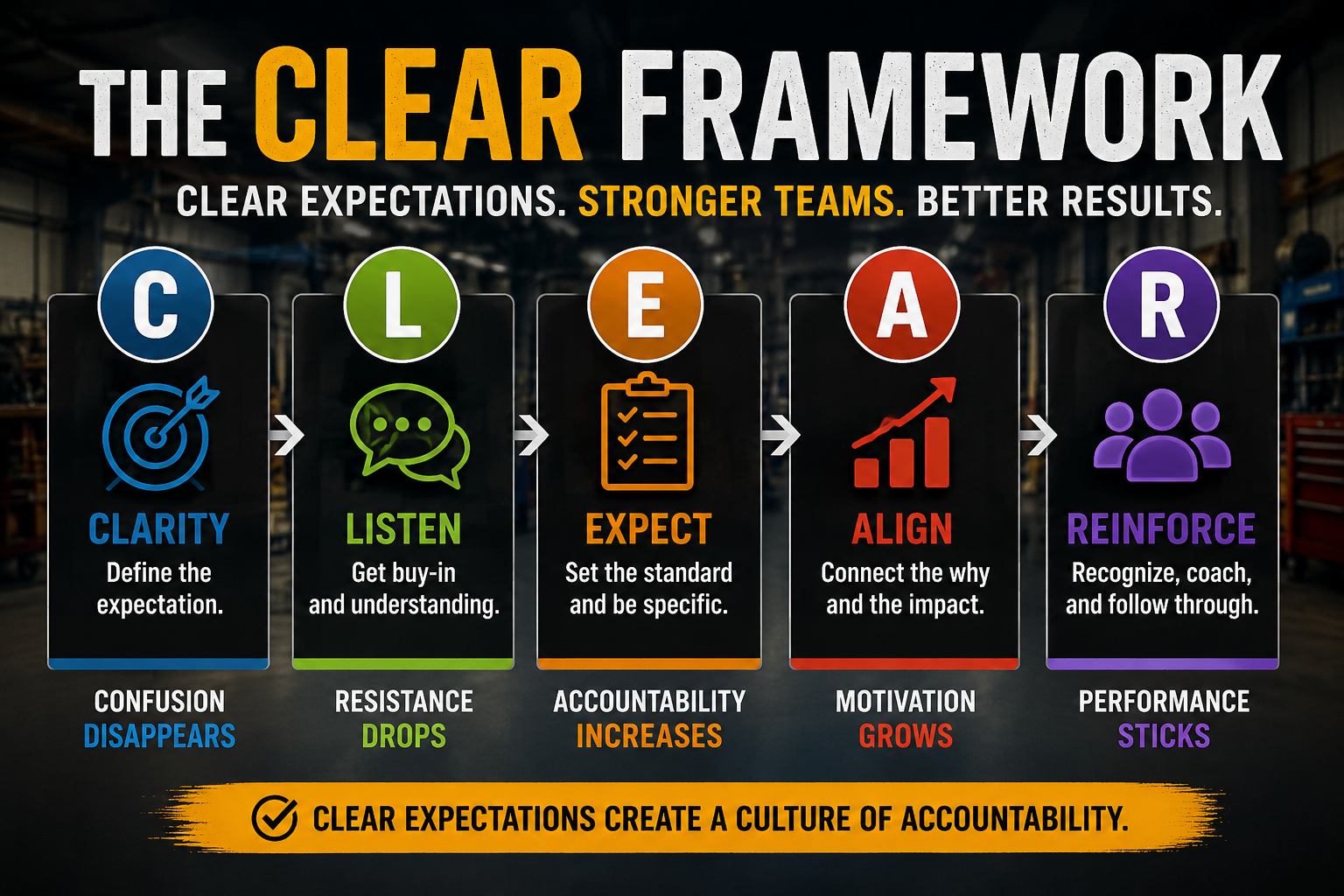
The CLEAR Framework
This is the framework I use to help shop owners create alignment, improve communication, and eliminate unnecessary frustration inside the shop.
C — Clarify the Outcome
Define the mission clearly.
What does success actually look like?
Not:
- “Try harder.”
- “Do better.”
- “We need to improve.”
That’s vague leadership.
Clear leadership sounds different:
- “Every vehicle gets a complete digital inspection.”
- “Every estimate gets followed up within 24 hours.”
- “We need 20 billed hours per day.”
If the outcome isn’t clearly defined, don’t expect consistent results.
Your team cannot hit targets they cannot see.
L — Link to Purpose
People don’t commit to tasks.
They commit to purpose.
Your team needs to understand why the expectation matters.
Why does it matter:
- To the customer?
- To the shop?
- To profitability?
- To the team?
- To their future?
Without purpose, employees go through the motions.
With purpose, they engage differently.
That’s when buy-in starts happening.
E — Establish the Standard
If you don’t define the standard, your team will create their own.
That’s exactly what happens in struggling shops.
A technician may think they had a productive day because they touched a lot of cars.
Meanwhile, the business measures productivity by billed labor hours.
Those are completely different scoreboards.
That disconnect creates frustration because everybody thinks they’re right.
You have to clearly define:
- What great looks like
- What matters most
- How success gets measured
And the standard must be measurable.
Because if performance is subjective, accountability disappears.
A — Align the Conversation
This is where most communication breaks down.
Owners think alignment happened because they explained something once.
It didn’t.
Alignment happens when the other person can repeat it back clearly.
That’s why I ask questions like:
- “What does this mean to you?”
- “How would you approach this?”
- “What does success look like here?”
Those questions expose confusion immediately.
And that matters because resentment lives between what you think you communicated and what they think they heard.
That gap right there destroys culture faster than almost anything else.
R — Reinforce Relentlessly
One conversation is not training.
Consistency is training.
You cannot talk about standards once and expect permanent change.
You have to reinforce expectations:
- Daily
- Weekly
- In the moment
- Repeatedly
That’s how habits are formed.
That’s how culture is built.
And honestly, this is where most shops fail.
Not because the people are bad.
Because the reinforcement disappears.
The Hard Truth About Leadership
If your team keeps missing expectations, you have two choices.
You can blame the team.
Or you can evaluate how clearly you’ve led them.
Only one of those gives you control.
The other just keeps you trapped in frustration while the same problems repeat month after month.
And look, this doesn’t mean every employee is amazing.
It means unclear leadership creates unnecessary failure.
That’s the part too many owners ignore.
Here’s What I Want You to Do
Pick one area in your shop where frustration keeps showing up.
Just one.
Maybe it’s:
- Vehicle inspections
- Workflow
- Follow-up
- Technician productivity
- Communication
- Sales consistency
Now ask yourself:
- Did I clearly define the outcome?
- Did I explain why it matters?
- Did I establish the standard?
- Did I confirm understanding?
- Did I reinforce it consistently?
Because if you skipped those steps, the confusion shouldn’t surprise you.
Clarity changes everything.
And when expectations become clear, performance improves fast.
Final Thought
Most shop owners don’t have bad teams.
They have unclear communication, inconsistent standards, and expectations that were never fully defined.
That creates frustration for everybody.
But once expectations become clear, people improve faster, accountability gets easier, and the entire shop starts operating with less tension and more consistency.
That’s when leadership actually starts working.
If you’re tired of repeating yourself, frustrated by inconsistent execution, or constantly feeling like your team “just doesn’t get it,” the issue may not be your people.
It may be the leadership systems driving the culture inside your shop.
That’s exactly what I help shop owners fix.
Book a Complimentary Call with me and let’s identify the communication gaps, expectation problems, and leadership blind spots holding your shop back.
Want to learn more about transforming your business?
Join my mailing list to get advice you can use to improve your shop, the day it lands in your inbox.
Don't worry, your information will not be shared.
We hate SPAM. We will never sell your information, for any reason.